How to use and customize the touch keyboard in Windows 11 – TechRepublic
Register for your free TechRepublic membership or if you are already a member, sign in using your preferred method below.
We recently updated our Terms and Conditions for TechRepublic Premium. By clicking continue, you agree to these updated terms.
Invalid email/username and password combination supplied.
An email has been sent to you with instructions on how to reset your password.
By registering, you agree to the Terms of Use and acknowledge the data practices outlined in the Privacy Policy.
You will also receive a complimentary subscription to TechRepublic’s News and Special Offers newsletter and the Top Story of the Day newsletter. You may unsubscribe from these newsletters at any time.
Username must be unique. Password must be a minimum of 6 characters and have any 3 of the 4 items: a number (0 through 9), a special character (such as !, $, #, %), an uppercase character (A through Z) or a lowercase (a through z) character (no spaces).
How to use and customize the touch keyboard in Windows 11
Your email has been sent
In Windows 11, you can use and tweak the touch keyboard when you don’t have a physical keyboard. Here’s how to use this handy feature.

Windows 11 offers a touch keyboard through which you can tap to type if you’re using a device without a physical keyboard. But there’s more to the touch keyboard than appears at first glance. Beyond accessing all the standard alphanumeric keys, you can insert keyboard shortcuts, emoji and symbols. You can adjust the size of the keyboard, change the size of each key and apply different visual themes. Here’s how.
First, the touch keyboard should automatically pop up when Windows 11 detects that you need to enter text but your device lacks a physical keyboard. However, you can also trigger the keyboard manually. To set this up, go to Settings, Personalization, and then Taskbar. Select the setting for “Taskbar Corner Icons” and turn on the switch for Touch Keyboard (Figure A).
Figure A
The touch keyboard icon then always appears on the Taskbar. Open an application, document, email or website where you can enter text, and then click the icon to display the keyboard. The touch keyboard works similarly to any other type of virtual keyboard. You can switch between lowercase and uppercase letters. Press down on one of the keys at the top to insert a number. Tap the &123 key to switch to numbers and symbols. Tap the microphone key to dictate text. You can also enter keyboard shortcuts by using the Windows key, Ctrl key or Alt key (Figure B).
Figure B
To insert emoji, animated GIFs or symbols, tap the second icon from the left (the one with a heart in a square). From here, tap each of the resulting icons depending on what you want to insert (Figure C).
Figure C
The touch keyboard also works with the universal clipboard in Windows 11, allowing you to paste not only the last item you copied but a history of the items you’ve copied. Copy an item in your current document or file, and it will appear in the top middle of the keyboard so you can paste it by tapping it (Figure D).
Figure D
To see all of the current items in your clipboard history, tap the second icon from the left again and then tap the last icon in the list, the one for universal clipboard. From the history, tap the item you want to paste (Figure E).
Figure E
To alter the size of the keyboard, tap the Gear icon at the left and move to Keyboard layout. You can choose among Default, Small, Split and Traditional (Figure F).
Figure F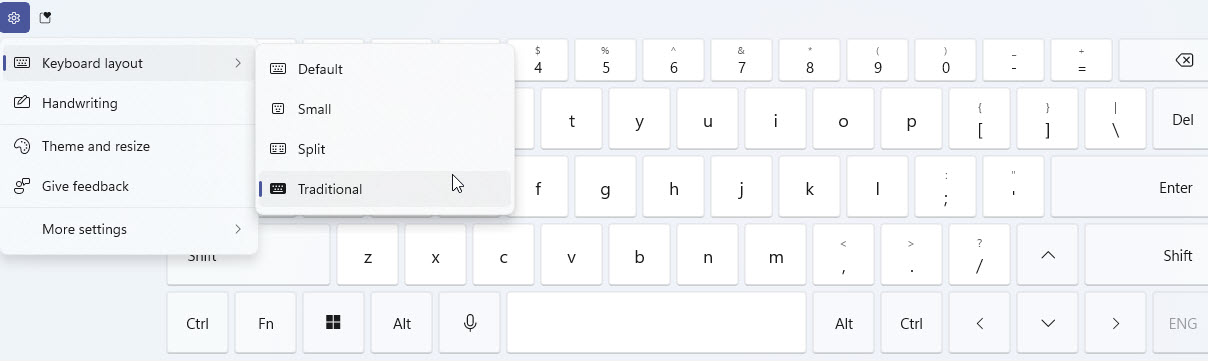
If you’d prefer to enter text by drawing it, click the Gear icon and select Handwriting. You can now use your finger or a stylus on a touch screen or your mouse on any type of screen to draw each character (Figure G). To return to one of the regular keyboards, click the Gear icon, move to Keyboard layout and select the layout you want to use.
Figure G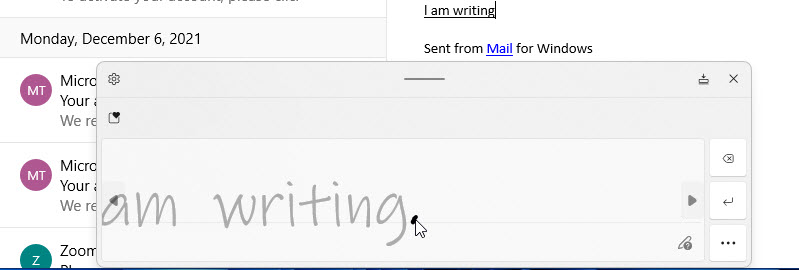
Want to control the size and look of the keyboard? Click the Gear icon and select Theme and resize. Move the slider for Keyboard size to precisely apply a specific size. Next, click one of the themes to repaint your keyboard with it. You can even create your own theme (Figure H).
Figure H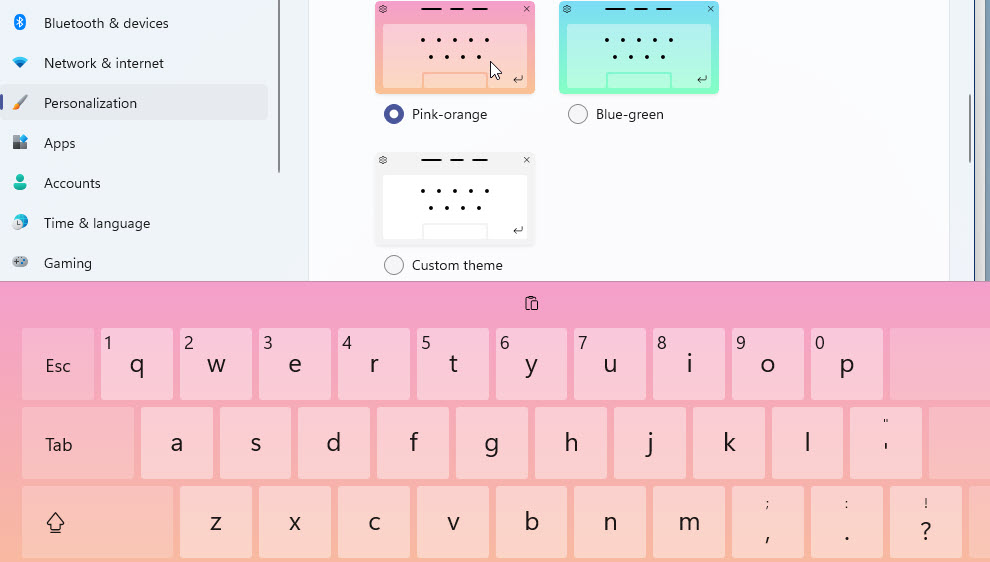
Scroll down further in the keyboard settings and you can turn the key background on or off and change the size of the keys among small, medium and large (Figure I).
Figure I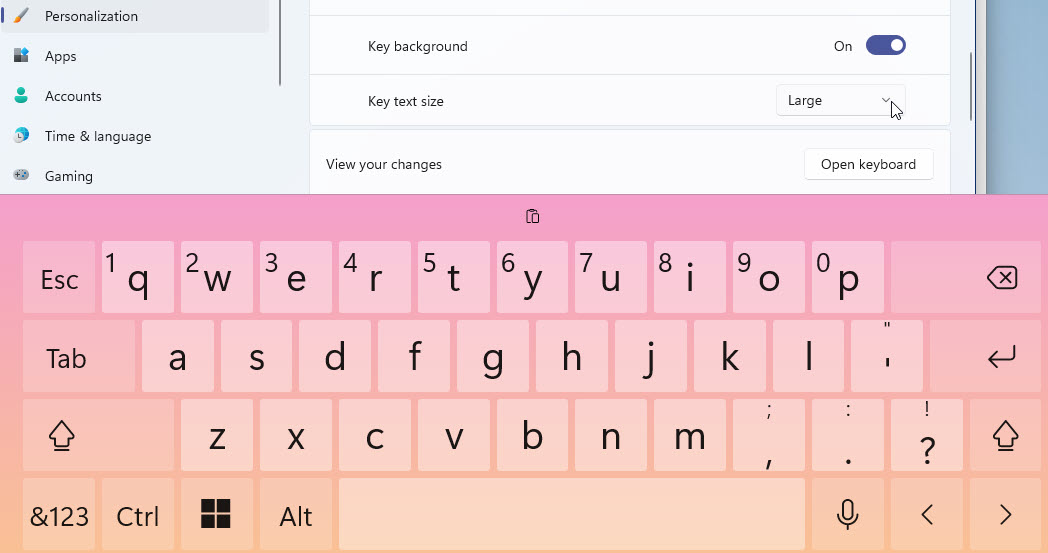
Next, click the entry for Typing settings at the settings screen. Here, you can enable or disable a few options, such as showing text suggestions, auto-correcting misspelled words, and highlighting misspelled words. Finally, select the entry for Language & Region to change or add a language and regional format for the touch keyboard (Figure J).
Figure J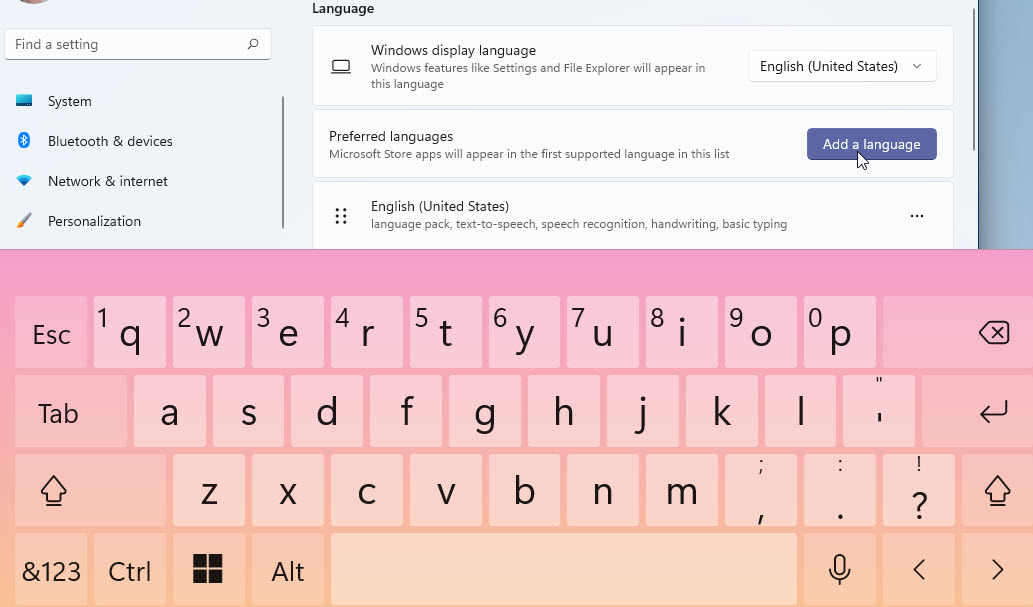
Be your company’s Microsoft insider by reading these Windows and Office tips, tricks, and cheat sheets.
How to use and customize the touch keyboard in Windows 11
Your email has been sent
Your message has been sent
Google Tasks has never had a solid interface … until now. Jack Wallen shows you how to turn Tasks into a kanban board-like workflow with the help of TasksBoard.
Don’t pack your bags and move to Bozeman yet. This micro-scale warp bubble won’t be capable of propulsion, but it could have myriad other applications, says its discoverer Dr. Sonny White.
Based on job demand, Python is the top language, followed by Java, JavaScript, C++, C# and C, says CodingNomads.
If you’re not certain whether your Java project is free from Log4j vulnerabilities, you should try this easy-to-use scanning tool immediately.
If you missed in-person tech events in 2020 and 2021, here’s some good news: It’s looking promising that in 2022 many conferences will get back to (almost) normal.
The comprehensive bundle covers a range of subjects, including app development, game development, machine learning, computer vision, deep learning, NFTs, Java and website building.
Storage has always been a key aspect of data management in the enterprise. Now, in the era of big data, understanding storage options and technologies has taken on an even greater significance. This glossary offers essential terms that will help you tune up your storage vocabulary. From the glossary: Cloud storage Cold storage is the …
Electronic data is likely to be more prevalent in today’s organizations than physical printed data. Reams worth of documents can now be stored on computer hard drives, handheld devices and storage cards smaller than a fingernail. The bulk of many strategic operations depend on this digital information and the safe handling thereof. Data often has …
The concept of a metaverse, or a computer-generated universe, has been around for decades, certainly longer than when it was recently commandeered by Mark Zuckerberg in his attempt to rebrand Facebook as a new company called Meta. Massively multiplayer games, which can be classified as early metaverses, have been widely available to the gaming public …
The OneDrive Cloud Usage Policy from TechRepublic Premium defines the practices and behaviors organization representatives must follow when using any Microsoft OneDrive Cloud file storage account to execute organization services, process organization data, or access or store organization information. Whether organization representatives access Microsoft OneDrive file storage capabilities using an organization-provided, organization-reimbursed or personal OneDrive …