Windows 11 vs Windows 10 GPUs Tested: Which Games Faster? – Tom's Hardware
Tom’s Hardware is supported by its audience. When you purchase through links on our site, we may earn an affiliate commission. Learn more
By published
A head-to-head with the fastest AMD and Nvidia GPUs.
I’ve been rather happily running and benchmarking graphics cards with Windows 10 since just after it launched in 2015. Microsoft tried to encourage people to upgrade by initially offering Windows 10 for free, plus it was the only OS with support for DirectX 12. Portions of DX12 were eventually backported to Windows 7, and you can still get Windows 10 for cheap, but now Windows 11 is the new kid on the block. So how does it perform, specifically with games? That’s what we wanted to find out, so we grabbed the two best graphics cards from AMD and Nvidia and put them to the test.
Let’s be clear: Change for the sake of change doesn’t go over well with me, and Windows 11 puts a new coat of paint on the worn-in and comfortable feeling Windows 10 house I’ve been living in since 2015. A new coat of paint would be fine, and I’m not necessarily averse to that. But in the process, it seems as though the UI designers felt a need to rearrange the furniture, switch around the drawers, and clean house on a bunch of functionality that I actually like.
We’ve covered some of the worst Windows 11 changes, and how to fix them. Ultimately, two months after release, our Windows 11 launch impressions remain largely unchanged, and we’re discovering even more disappointing aspects to the OS—like the Windows 11 SSD issues, which apparently still persist. With that in mind, I wanted to verify that Windows 11 doesn’t impact graphics card performance before switching to the new OS. Of course, that switch is still in the works since I’ll be shifting to an Alder Lake Core i9-12900K system for GPU reviews in the near future. And of course, using Alder Lake is one of the only good (sort of) reasons to switch to Windows 11, thanks to the new process scheduler that integrates with Intel’s Thread Director hardware.
Intel Core i9-9900K
MSI MEG Z390 Ace
GeForce RTX 3080 Ti FE (497.09 drivers)
Radeon RX 6900 XT reference (21.12.1 drivers)
Corsair 2x16GB DDR4-3600 CL16
XPG SX8200 Pro 2TB (Win10)
Crucial P5 Plus 2TB (Win11)
Thermaltake Toughpower GF1 1000W
Corsair Hydro H150i Pro RGB
Phanteks Enthoo Pro M
Windows 10 Pro 2H21 (Build 19043.1348)
Windows 11 Pro (Build 22000.348)
What if you’re not using Alder Lake, though? I took my current GPU testbed, which is now about three years old, and did a clean install of Windows 11 on a new Crucial P5 Plus SSD for testing purposes. I tested basically the fastest graphics cards from AMD and Nvidia, the Radeon RX 6900 XT and GeForce RTX 3080 Ti, and I also retested those cards on Windows 10 using the latest drivers and updates. (Yes, technically the 3090 is a bit faster and has twice the VRAM, but it’s close enough and the 3080 Ti tends to be more readily available.) That means running the AMD 21.21.1 and Nvidia’s 497.09 drivers, with a complete driver cleanup (via Display Driver Uninstaller) between testing. Here are the results of the 14 games I used for testing.


Across our 14-game test suite, the overall performance difference between Windows 10 and Windows 11 at three resolutions was less than one percent. There was one instance where Win10 was 4% faster (RTX 3080 Ti in Far Cry 6), and Assassin’s Creed Valhalla was consistently 3% faster, but a few minor anomalies are to be expected. Sometimes Windows 10 was a bit faster and sometimes Windows 11 came out ahead, but in practice there wasn’t any significant change.
The minimum fps (technically 99th percentile frametime converted to fps) results show a bit more variability, but that’s always the case. Here we see an instance (Strange Brigade on the RTX 3080 Ti) where Win10 beat Win11 by 10%, and there are a few other cases of 5% differences, but a single frame or two rendering slowly can easily skew the results. That’s why we don’t place as much emphasis on minimum fps.
Interestingly, the RX 6900 XT was far more consistent in its performance across the two versions of Windows, where average fps was within 0.3% overall, and the biggest differences were still less than 2%. Even the minimum fps only had up to a 5.5% difference, and in that case, it was Windows 11 coming out ahead.
If you prefer seeing things in chart form rather than the above tables, here’s a gallery of all 45 of the 1080p, 1440p, and 4K results. (Note: The above table uses the geometric mean for average, where all values are given equal weight, while the 14 game average charts below use the arithmetic mean and can skew due to “outlier” results.)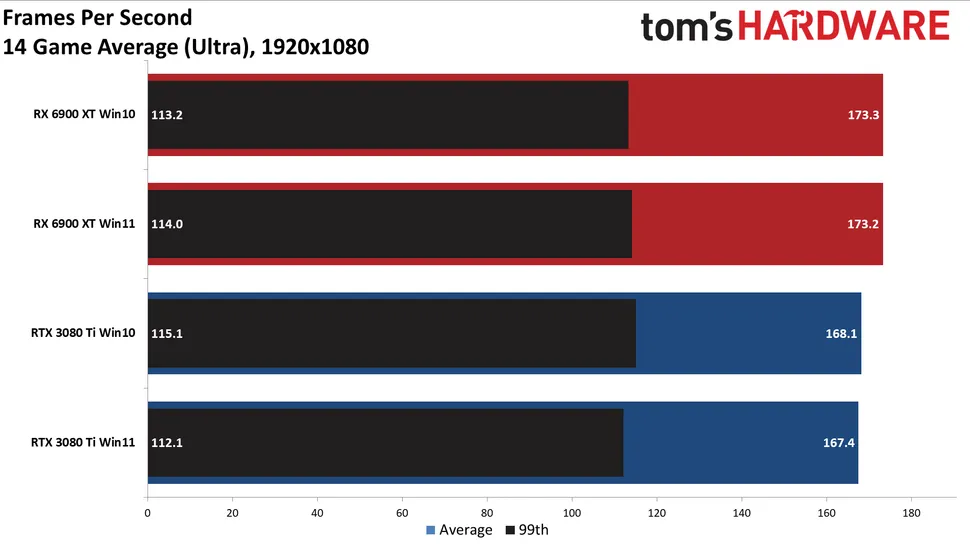


If you’re curious, I’m planning on using the following games for the coming year of graphics card reviews: Borderlands 3, Dirt 5, Far Cry 6, Flight Simulator, Forza Horizon 5, Horizon Zero Dawn, Red Dead Redemption 2, and Watch Dogs Legion. Note that seven of those use DirectX 12, with Red Dead being the sole Vulkan representative—and there are no DirectX 11 games in the list. I’ll also use a somewhat different suite for ray tracing tests: Bright Memory Infinite, Control, Cyberpunk 2077, Far Cry 6, Fortnite, Metro Exodus Enhanced, Minecraft, and Watch Dogs Legion, with the goal being to use games that show some real visual benefits from enabling ray tracing. (Feel free to comment below if you think I’ve missed any game that warrants inclusion.)
Jarred Walton is a senior editor at Tom’s Hardware focusing on everything GPU. He has been working as a tech journalist since 2004, writing for AnandTech, Maximum PC, and PC Gamer. From the first S3 Virge ‘3D decelerators’ to today’s GPUs, Jarred keeps up with all the latest graphics trends and is the one to ask about game performance.
Get instant access to breaking news, in-depth reviews and helpful tips.
Thank you for signing up to Tom’s Hardware. You will receive a verification email shortly.
There was a problem. Please refresh the page and try again.
Tom’s Hardware is part of Future US Inc, an international media group and leading digital publisher. Visit our corporate site.
© Future US, Inc. 11 West 42nd Street, 15th Floor, New York, NY 10036.